Frank Kogovšek’s Life Well-Lived
By Louise Sulecki and Jim Sulecki
After our father and father-in-law Frank Kogovšek Sr. passed away suddenly but peacefully in late May at age 86, our family received so many kind words and thoughts about him, and understandably so, because his was a generous and successful life—one of hard work, unflagging support of his family, and tireless service to the Slovenian community.
And yet, any memorial can’t fully capture the full extent of a life well-lived. Allow us, then, to paint a more complete picture of Frank’s life, because while his story is uniquely his, it’s also representative of the many Slovenians who migrated from the “old country” and built a new life in America.
Early Adventures in Slovenia
Frank’s father, Janez Kogovšek, was older than Frank by a span of 52 years. Janez, born in 1887, served as a very diplomatic mayor of the Šentjošt area of Slovenia, and was among an estimated 160,000 to 170,000 Slovenian men conscripted into the Austro-Hungarian army during World War I. After his first wife passed away in 1926, in 1931 he was remarried — in what seems now like a scene from The Sound of Music — to Marija Gantar, who lived with the family and helped care for the household and children as was common in many European homes in the 1930s. In 1939 Marija became mother to Frank, born Frančišek, who was the seventh of nine children including his younger sister Theresa (Rezka) Rus, also known to many in the Cleveland Slovenian community.
As a boy growing up in the high hillside village of Smrečje (Notranjska), Frank was energetic, adventurous, and resourceful, tending to cows on the farm and cutting trees for the sawmill. He was especially capable with his hands, and by his teens had become known as the local fix-it man. We still recall a moment from Frank’s final trip to Slovenia in 2006 when on a family visit to the old Kogovšek homestead, his nephew, now running the farm, brought forth a handful of wooden objects that apparently had been squirreled away in an old barn. They were pieces of woodworking Frank had fashioned when he was only about five years old.

Celarski 1941 – Front row from left: children France, Ivanka, Francka; second row: Mici, father Johan, mother Micka (nee Gantar) with Jožef, old father Janez, Ivan; back row: Marjanca and aunt Marjana Kogovšek
Frank often skied to school in the wintertime, given the steep local terrain. He also frequently bicycled, which gave rise to a story he liked to tell: the time he sped down a hillside with bravado, hands-free, hoping to show off to a local girl named Ivanka, only to lose control and crash his bike. On another occasion, in an attempt to prove to his friends that the nose and mouth are connected, drew a string through his nasal passages to his mouth. Having caused some internal bleeding, he saw fit to take himself to a local hospital where a doctor insisted on keeping him overnight for observation. Only at dinner did his mother openly wonder about Frank’s whereabouts. It seems Frank’s bike had been spotted standing just outside the hospital.
A more serious and harrowing episode in Frank’s early life was his recollection from somewhere around age five of postwar skirmishes waged in the hills just above the family homestead. Frank recalled the sound of gunfire and hitting the ground for cover.
Frank came to meet his future wife Ivanka (Jennie) Rus while both still were in Slovenia. Jennie’s older sister married a man who knew families in Smrečje, including the Kogovšeks. So began a meeting of the Kogovšek and Rus families that in time would yield not just Frank’s and Jennie’s marriage but also two other Kogovšek-Rus unions.
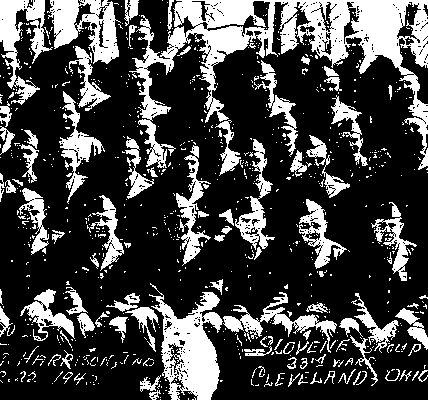
Frank left Smrečje for an extended period twice before he departed for the United States: once to attend machinist school in Stuttgart, Germany, during which time his father passed away; and the other to fulfill mandatory service in the Yugoslav Army, during which he recalled observing a total solar eclipse from a mountainside military installation.
Coming to America
America beckoned to Frank, especially because of the prospect of a reunion with Jennie, who’d already left Slovenia to join most of her family on the near east side of Cleveland. In 1963, Frank and Jennie were married at St. Vitus Church, then took up residence on the first level of a duplex house in the Collinwood neighborhood just a few streets from St. Mary Church on Holmes Avenue. Very soon came children Frank Jr. and Louise, followed by David, Monika, and Majda.
But Frank and Jennie were determined to have a house and land of their own. For several years they walked dozens of lots in the eastern suburbs of Cleveland before finding a rustic acre-and-a half at the very end of a cul-de-sac in Willoughby Hills. There, in the mid- to late-Sixties, Frank built—by hand—a large, brick split-level house, aided by family members and others while their young children played nearby.
With electricity still not pulled to the new development and with no other houses nearby yet — Frank and Jennie were the pioneers of that end of Meadowbrook Drive, though soon they would be joined by other family members and Slovenians in what is still known as “the circle” — Frank in his eagerness ran a super-long electrical cord down the street in order to pull power to run his tools and lights until electricity was permanently installed. In December 1967, the family moved in, and Jennie still lives there today.
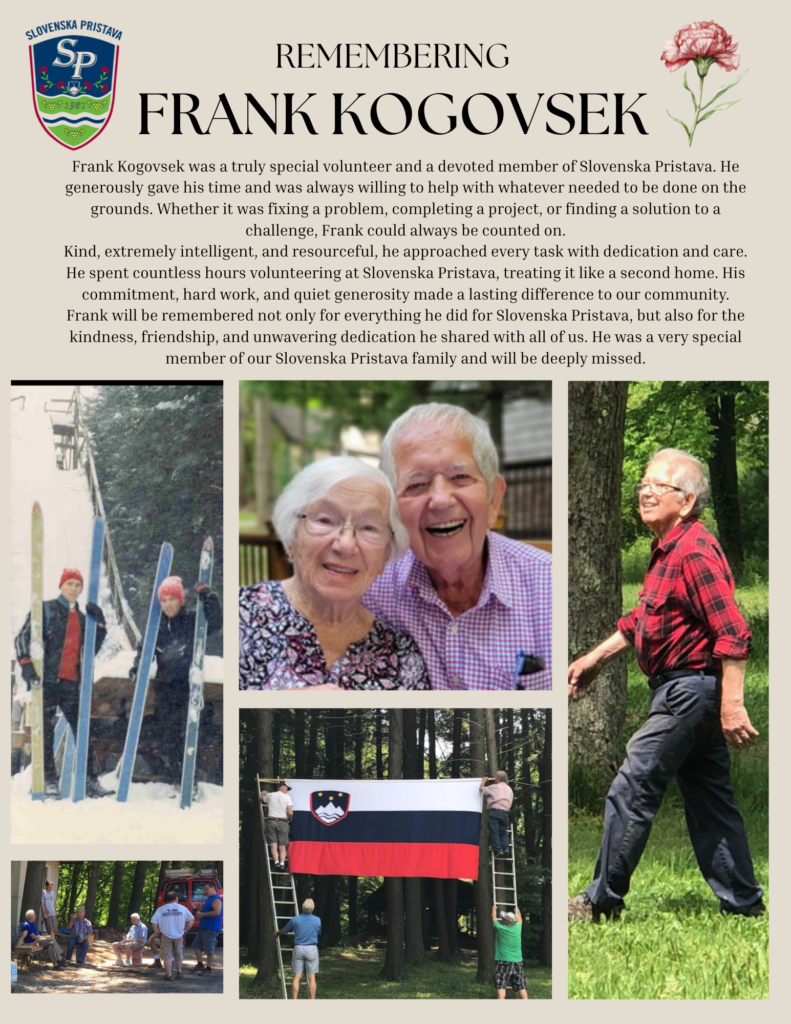
Somehow even with working full-time, raising a family, and building and furnishing a new house, Frank found time to volunteer at his beloved Slovenska Pristava—then just a handful of years old and still very much under construction. It was Frank and his brother-in-law, Stan (Stane) Rus, who spearheaded the building of an Olympic-style ski jump that lives on in Pristava lore.

Frank worked for years first at National Acme, then at PAKO Inc., a manufacturer of jet engine and industrial turbine parts where he was promoted to foreman. Even after he “retired” from PAKO in 2004, he remained on the list of active employees and continued going back to the shop on an almost daily basis. Likewise he was a frequent visitor to Lowe’s, where they knew him well from his many excursions for lumber, tools, and miscellaneous parts.
A Slovenian through and through, Frank rarely threw anything away. In fact, he built a two-story garage in the backyard of his house expressly to store all the odds-and-ends he was certain would be needed someday. Many of them were used, though many others still remain in the garage.
Always of Service
Frank tirelessly helped his five children with their houses and yards, fixing and expanding and enhancing. He would show up as spry as the Roadrunner, the back end of his car pitched downward from the weight of his many tools and spare parts in the backseat and trunk, and often with a trailer hitched to the bumper. He would be ready to work until he got stuck, at which point he would take a step back, chin in hand, and say quietly, “I have to think about it.”
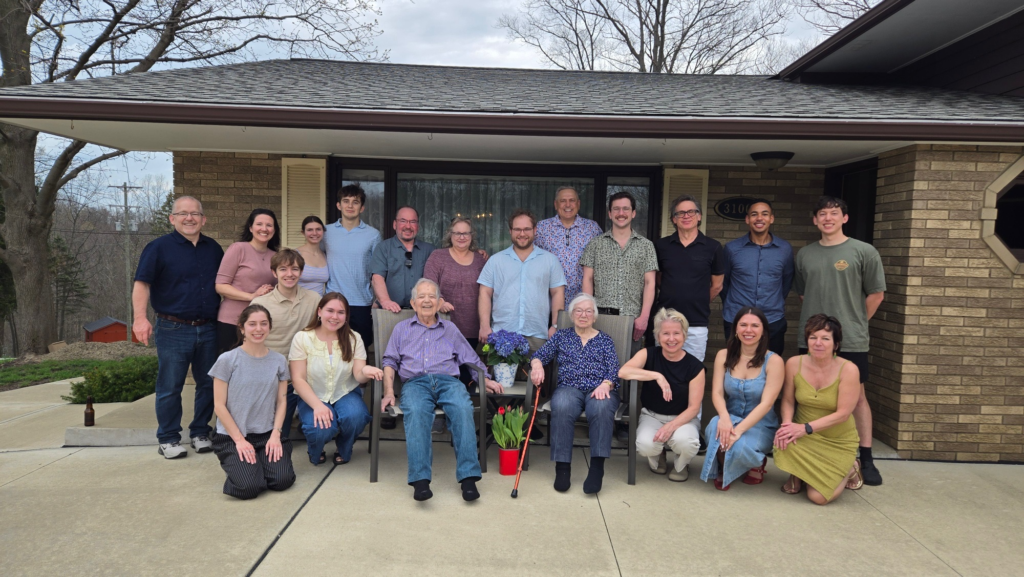
In fact, it was during our many home-improvement projects that Frank was heard to utter the familiar sayings we now think of as “Ati-isms.” For instance, if a screw or a piece of material refused to comply with his intent, he would mutter under his breath, “It’s fighting me!” Once a major step or a project was complete at last, he would say brightly, “That’s it!” And as he left after a long day or evening of working, his head swimming with details and plans and modifications, he often would stop, turn, and say, “Oh—and one more thing.”
Frank’s homemade trailer, a reliable relic of the Sixties that of course is still operable today, was a key feature in most of our home projects. When as newlyweds we moved from a small apartment to our first house, Frank piled up nearly all of our worldly belongings into this trailer and also lashed a small table to the roof of his car — surely a sight to behold to our new neighbors as we rolled up the driveway.
After Frank was retired and his children and then his grandchildren were grown, he continued as an almost daily presence at Slovenska Pristava, fixing this, tinkering with that, and always, always thinking and planning, right up to his final hours — how this could be built, how that could be fixed or improved. We often heard he always had a smile on his face, that he touched many people and that he was friends to everyone. This we can corroborate — it sometimes took Frank a good half-hour just to make a “quick” trip from the Pristava picnic area to the bar because there were so many people to chat with along the way.
The Slovenian Story
This is Frank’s story, but as we say, it’s also part of a wider Slovenian-American story. We imagine many of us are able to see in so many others the qualities we saw in our father and father-in-law. Frugality with generosity. Innate intelligence. Hard work. Attention to detail. An insistence on quality, and timelessness. Thoughtfulness. Service. Loyalty. Fun. Love. Laughter.
And family. Always family, including the extended Slovenian family.
From Slovenska Pristava: