By: Paul Zakelj (assisted by AI)
Remembering Orlov Vrh
In September 1943, following Italy’s surrender to the Allies, the Slovenian Domobranci (Home Guard) was formed to fight the Partisans and resist the establishment of communism in Slovenia. That same year, the Home Guard established a military cemetery at Orlov Vrh (Eagle’s Peak) in Ljubljana. The first funeral took place in December 1943, and the last in April 1945. In total, 146 fallen Home Guardsmen were laid to rest in this cemetery. [ref.: Glasilo Nova Slovenska Zaveza, “Kaj Je Treba Vedeti: Orlov vrh – domobransko pokopališče”, Nov. 9, 2019]
Sadly, the cemetery was desecrated and destroyed by the communist regime in 1946. Even in death, Domobranci were a threat to the communist regime.
The struggle for recognition and preservation of this sacred ground continues to this day.
In memory of all Slovenian Domobranci buried at Orlov Vrh, and all those resting in unmarked and hidden graves throughout Slovenia, may they rest in God’s peace.
The English translation of the 10-year memorial of the establishment of Orlov Vrh, originally published in Slovenian in Šmartinski Vestnik (San Martin, February 1, 1953, No. 6), follows.
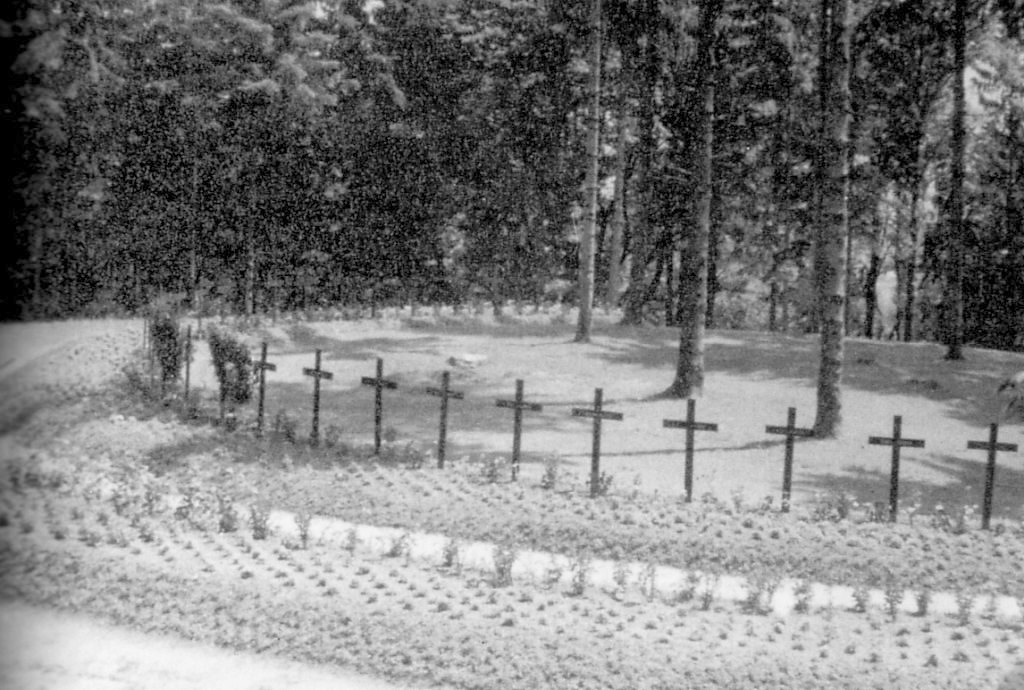

Orlov Vrh at Ljubljana Castle
Soon after the establishment of the Home Guard (Domobranci), a noble idea arose: “Let us create a sacred resting place in the heart of our Slovenian homeland, in Ljubljana, and, whenever possible, let all fallen and deceased Home Guardsmen be buried in this common cemetery of the Slovenian Home Guard, which shall forever remain a sacred place for all Catholic and anti-communist Slovenians.”
To this noble idea was joined another, equally fitting one: “Let this resting place be established at Ljubljana Castle, to shelter the bodies of our heroic fighters.”
And indeed, it became reality. A few hundred meters from the old fortifications, beneath the ramparts of Ljubljana Castle, in a quiet grove of whispering fir trees, Slovenian young men prepared a spacious burial ground where our fallen Home Guardsmen, or those who died of wounds, were laid to rest in beautiful military order, side by side, just as they had so often stood together in life on Lower Carniola and Inner Carniola in well-disciplined ranks.
And when All Souls’ Day arrived, a moving ceremony took place at Orlov Vrh. Every grave was adorned with flowers and candles; the entire sacred field was beautifully decorated for their feast day. As many Home Guardsmen as possible assembled there in proud formations, together with many civilians, even more of them coming from the countryside, filling the murmuring woodland. A senior Home Guard commander spoke in memory of the dead, emphasizing their sacrifice for the homeland and for civilized humanity.
Then a senior Home Guard officer called each fallen fighter by name, and in place of the individual, his company commander answered: “He fell for the homeland!” Thus, the solemn response was repeated annually through an ever-lengthening list of names. The moving ceremony deeply stirred the surviving comrades-in-arms and their attending families. Afterwards, the military chaplain offered prayers for the fallen.
But now there is no longer a sacred field at Orlov Vrh — no crosses, no wreaths, no candles, and no graves.
When they seized power in Ljubljana, the vile communist executioners desecrated the beautiful and peaceful resting place. They tore out the crosses and cast them away, trampled the flowers, extinguished the candles, destroyed the graves, and plowed over the sacred ground so that no trace remained of the small mounds that had once risen above the decaying bodies of Slovenian Catholic men and boys — fighters.
Words fail us — and so does the pen.
To abuse the dead and display one’s “power” in such a manner is the act of a foul scavenger beast — a hyena — overturning graves to gnaw upon the bones of the dead. Can such vile butchers ever, anywhere, be counted among civilized humanity? There is no deed capable of erasing from their souls and from history such barbaric acts.
Therefore, we boys and men must preserve the memory of those great departed heroes from the gentle village of the deceased — Orlov Vrh.
Let us sing our old Slovenian military song:
Oh, that military drum,
it shall be my great bell,
oh, it shall ring for me,
when I die. Bim, bom.
Oh, that military saber,
it shall be my shining light,
oh, it shall shine for me,
when I die. Cin, cin.
Oh, that green meadow,
it shall be my final home,
there I shall rest,
when I die. Bim, bom.
Oh, these Slovenian boys
will bury me,
they will all escort me
to green meadows. Bim, bom.
Orlov Vrh na Ljubljanskem Gradu
Kmalu po ustanovitvi domobrancev se je dvignila lepa misel: Napravimo si božjo njivo v osrčju naše slovenske domovine v Ljubljani in po možnosti polagajmo vse padle in umrle domobrance v to našo skupno pokopališče slovenskih domobrancev, ki bodi za vedno svet kraj vsem katoliškim in protikomunističnim Slovencem.” K tej lepi ideji se je pridružila še druga, prav primerna. “Na ljubljanskem gradu bodi ta mirodvor, ki bo kril trupla junaških borcev.” In zares! Nekaj sto metrov od starih utrdb, pod šancami na 1jubij gradu, v tihem šumečem smrekovem gozdiču so slovenski fantje pripravili obširen prostor, kamor so legali naši padli ali od ran umrli domobranci v lepem vojaškem redu drug poleg drugega, kot so toliko- krat prej med živimi stali na lepem Dolenjskem in Notranjskem v lepo ure-jenih vrstah. In ko je prišel vseh mrtvih dan, tedaj se je vršil na Orlovem vrhu ginljiv obred: Vsi grobovi so bili v rožah in lučkah, vsa božja njiva lepo okrašena za njihov praznik. Kar moč veliko domobrancev v strumnih odre-dih in mnogo civilnega prebivalstva, še več z dežele, je napolnil šumeči gozdič. Višji domobranski poveljnik je govoril mrtvim domobrancem v spomin, povdarjajoč njihove žrtve za domovino in kulturno človeštvo. Nato je pa višji domobranski častnik pozival po imenu vse počivajoče borce — a mesto posameznika je odgovoril njegov četni poveljnik: “Je padel za domovino!” — in tako se je ponavljal tak pretresljiv odgovor vsako leto v večji vrsti. Ginljiv obred je pretresel žive soborce in njihove navzoče domače. Nato je vojaški kurat izvršil molitve za mrtve — padle.
Zdaj pa ni več božje njive na Orlo-vem vrhu — ne križev — ne vencev — ne lučk in ne — grobov.
Podli krvoloki — komunisti — so ob prevzemu oblasti v Ljubljani opustošili lepi tihi mirodvor! Križe so populili in zmetali proč, cvetke so pomandrali, lučke so pogasili — grobove zrušili in božjo njivo preorali, da se ne pozna več, kje so se bočile male hišice nad gnijočimi in zgnitimi trupli slovenskih katoliških mož in fantov — borcev. Zastaja nam beseda — pero!
Znašati se nad mrtvimi in tako kazati svojo “oblast” je lastno grdi smrdljivi živali — hijeni — ki prevrača grobove, da ogloda kosti mrtvih.
In naj bodo tako podli krvoloki kdajkoli in kjerkoli uvrščeni med kulturno človeštvo? Ni ga dejanja, ki bi mogel zbrisati z njih duše in zgodovine taka barbarska početja!
Zato pa mi fantje in možje dvigajmo spomin velikih pokojnih — junakov iz prijazne vasice mrtvih — Orlov vrh.
Zapojmo našo staro slovensko vojaško:
Oj ta vojaški boben,
ta bo meni vel’ki zvon,
oj ta mi bo zazvonil,
kadar jaz umrl bom. Bim, bom.
Oj ta vojaški sablja, ta bo meni svetla luč,
oj ta mi bo svetila,
kadar jaz umrl bom. Cin, cin.
Oj ta zelena trata,
ta bo meni zadnji dom,
oj tamkaj bom počival,
kadar jaz umrl bom. Bim, bom.
Oj ti slovenski fantje bodo pokopali me,
vsi bodo me spremili
na zelene travnike. Bim, bom.